

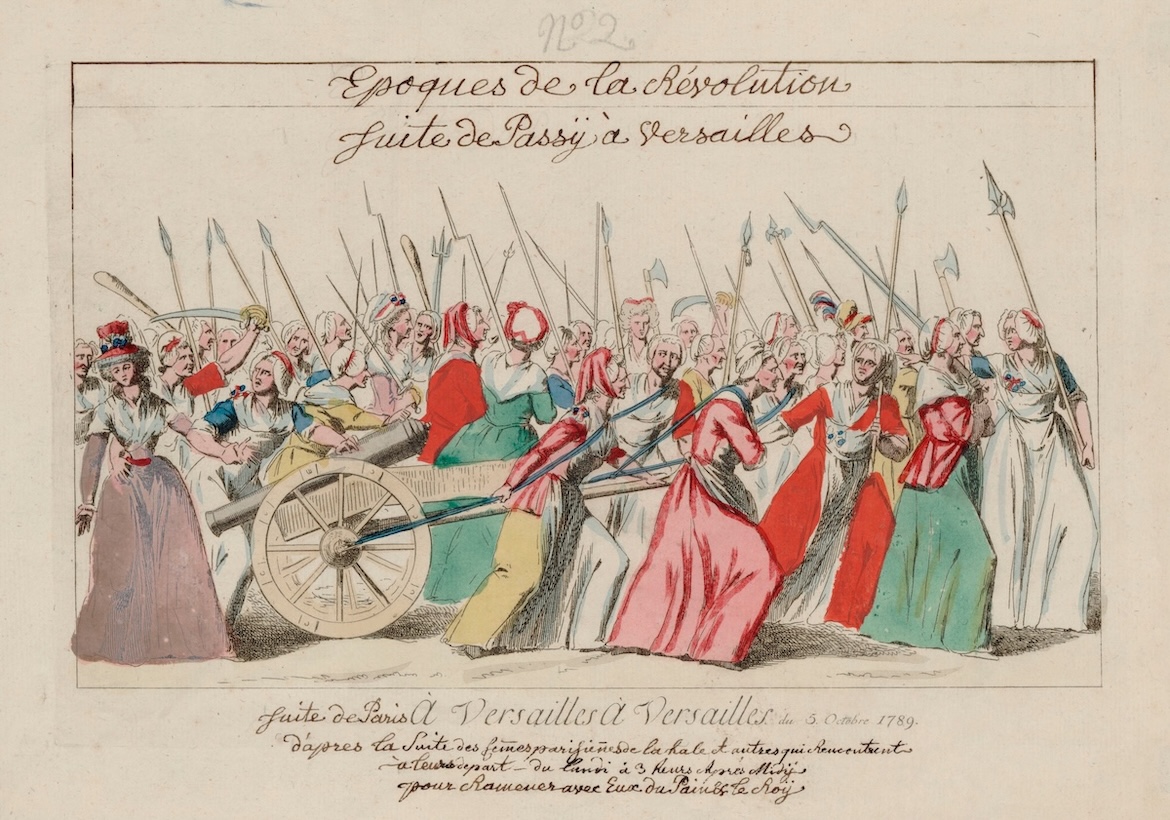
This wasn't a planned military operation. It was a spontaneous uprising born of hunger and fury, proving that the most potent revolutionary force often comes from unexpected places—in this case, the market stalls of Paris.
The Spark: Bread and Rumors
In the autumn of 1789, Paris was starving. A poor harvest had led to grain scarcity, sending bread prices soaring. For the working class, bread was the primary source of calories, and many mothers found themselves unable to feed their children.
While Paris hungered, rumors swirled about the excesses at the Palace of Versailles, located about 12 miles outside the city. The ultimate trigger was news of a lavish banquet held by the royal bodyguards on October 1st. Reports circulated that officers had drunkenly trampled the revolutionary tricolor cockade while pledging loyalty solely to King Louis XVI and Queen Marie Antoinette.
For the women of the Paris markets—the tough, outspoken poissardes (fishwives)—this was the final insult. The King had food, and his guards were insulting the people.
The March Begins
On the morning of October 5, a young woman struck a marching drum at a Paris market. Her beat drew a crowd. Soon, thousands of women—market traders, laundresses, and mothers—gathered. They raided the city hall for weapons and began the long trek to Versailles in driving rain, dragging cannons with them.
Their initial demand was simple: bread. But as the hours passed and thousands of National Guardsmen (led reluctantly by the Marquis de Lafayette) joined the rear of the procession, the demands grew political. They didn't just want flour; they wanted the King to return to Paris, away from the "corrupting" influence of the aristocracy at Versailles.
Confrontation at the Palace
The soaking wet, muddy crowd arrived at Versailles in the evening. A delegation of women met with King Louis XVI, who promised to release grain stores from the royal granaries. Some women were pacified, but the majority remained outside, their anger simmering through the night.
In the early hours of October 6, chaos erupted. Small groups of protesters found an unguarded entrance into the palace. They clashed with royal guards, leading to violence and death inside the gilded halls. The mob famously sought out the despised Queen Marie Antoinette, who barely escaped to the King's apartments via a secret passage.
The October Days: A Turning Point
To calm the violent crowd, Lafayette convinced the royal family to appear on the balcony. The crowd’s response was overwhelming and unified. They chanted, "To Paris!"
King Louis XVI, realizing he had lost control, had no choice but to agree. On the afternoon of October 6, a surreal procession departed Versailles. The royal carriage, surrounded by National Guards and thousands of triumphant women carrying loaves of bread on pikes, made the slow journey back to the capital.
The Women’s March on Versailles was a crucial turning point in the French Revolution. By forcing the King to relocate to the Tuileries Palace in Paris, the people effectively placed the monarchy under house arrest. The absolute power of Versailles was broken, proving that the common people—specifically the women—were a force that could topple kings.
© Photo: